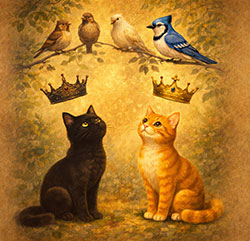
The next morning, the Council of Birds convened.
This was not a formal council, but the sparrows called it one because they enjoy drama.
The doves claimed that daylight was the greater threat. “Visibility,” one dove murmured gravely. “It makes intentions obvious.”
The sparrows disagreed. “At least we can see him. Darkness hides.”
The blue jay, who prided himself on objectivity, hopped forward.
“The orange one desired,” he declared. “The black one assessed.”
“Assessed what?” squeaked a sparrow.
“Us,” said the blue jay.
This caused general panic until the woman refilled the feeder, which temporarily restored morale.
Days passed.
The orange cat returned twice more, always in daylight, always wearing the expression of a tourist denied entry to a museum.
Each time the woman emerged and asserted the border. Each time he retreated — annoyed, but not humiliated.
The black cat appeared only once more. Again at night. Again silent.
He paused longer this time, near the seedlings.
The woman felt something she could not name — not fear exactly, not anger. Recognition, perhaps.
He looked at the fragile green attempts toward miniature trees. Then at the orchids, carefully tended. Then at the bird houses. And in that gaze was a question.
How long do you think you control this?
The woman did not move. The black cat moved on.

The story might have ended there, as simple territorial skirmish.
But balance rarely leaves without leaving a message.
One afternoon, a sparrow chick — reckless, newly confident in wing — misjudged a landing. It fluttered down near the tiles, close to the open edge of the patio.
The orange cat was not there. The black cat was not there.
The woman was.
She stepped out slowly. The chick hopped, confused, too young to understand geometry.
She bent carefully — tremors and all — and guided it gently toward the shrub.
The chick vanished into leaves.
In that moment she understood something uncomfortable: She was not eliminating danger.
She was postponing it.
Cats exist.
Instinct exists.
Shadow and sunlight both move through the world without asking permission.
Her task was not to abolish them. Her task was to guard the threshold as long as she could.
That evening, as the sun dipped and the patio cooled, she stood outside with the watering can. The garden shimmered in that hour when light and dark negotiate terms. From the far fence, two shapes appeared.
Orange.
Black.
They did not approach the feeders. They did not crouch. They simply sat.
Day and Night. At the same time. Watching.
The birds were already safe in their houses.
The woman stood between door and garden.
Three forces aligned.
Attraction.
Repulsion.
Equilibrium.
The orange cat flicked his tail.
The black cat blinked slowly.
And for one suspended moment, no one moved.
Then, as if governed by a law older than patios and feeders and human anxieties, the orange cat turned toward the fading light.
The black cat dissolved into the first true shadow.
The woman exhaled.
The birds slept.
And the garden remained what it had always been:
Not a possession.
Not a fortress.
But a threshold — where forces cross, and a guardian stands, not to conquer the world, but to keep a small circle of song intact.
For now.