I woke to a stillness that didn’t feel like peace, but like something watching. The air had that strange hollow quiet that follows violence—too clean, too arranged, as if the world were pretending nothing had happened. A lie of a morning. Tamblin was gone.
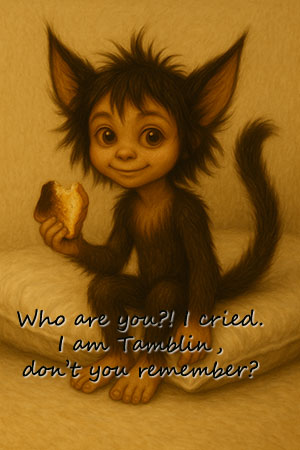
For a heartbeat I wondered if I had dreamed him—the golden eyes in the dark, the storm that felt alive, the feather that pulsed with warmth in my hand. Maybe I had imagined it all. But then I stepped from the library into the hall, and saw the trail of small wet footprints leading toward the kitchen. Someone was sitting on the counter, on a pillow from my sofa. This being was perfectly calm. Legs swinging. Eating bread he had toasted himself—badly. One corner burned black, the other still white. He glanced at me as if he had always lived here.
“Who are you?” I asked—though it came out closer to a cry. “Who are you, and how did you get into my house?”
“You don’t lock your doors,” he said.
“I did,” I answered. Then, before I could stop myself, I added, “And where is Tamblin?”
But even as I spoke, the truth settled over me like a whisper already waiting to be heard. He was Tamblin. I didn’t understand how that tiny forest creature from last night—the one who seemed more wild fox than person—had become this small, sharp-eyed being sitting in my kitchen. Yet my heart knew. This was Tamblin: storm-fighter, feather-bearer, wanderer between worlds.
He looked away, as if embarrassed by the shape he now wore—like he hadn’t chosen it, but had accepted it out of necessity. There was an age in him that did not belong to children—or even to mortals. Something old traveled with him. Despite the brave eyes, he seemed fragile, as though he feared I might send him away now that I had seen him as he truly was.
“Not all doors are made of wood.”
I didn’t know what that meant. I didn’t like that I didn’t know. But I didn’t ask. Something in me already understood that questions with him were like keys—you don’t use them unless you’re prepared for the door to open.
Lightning had burned through half the night and I had barely slept, yet I didn’t feel tired. I felt… aware. Sharp inside. As if the storm had woken something that had been dormant too long.
“Coffee?” I asked.
He nodded seriously, as if this were an important ritual. Maybe it was.
While the machine hummed, I looked around the kitchen. Nothing broken. Nothing out of place. Everything peaceful. And yet the hair at the back of my neck still stood up. Something wasn’t right. I reached for the feather to reassure myself—and froze. It was no longer on the shelf where I had left it.
I turned to Tamblin. He didn’t look alarmed. He didn’t even stop chewing.
“Where is it?”
He swallowed, then met my eyes—steady, unblinking.
“It moved,” he said.
“Feathers don’t move.”
“This one does.”
My heartbeat had begun that strange hollow pounding again. “Where did it go?”
He slid down from the counter and walked to the window over the sink, pointing outside. “It’s not far. But we should hurry. When it moves,” he said quietly, “they can feel it.”
“Who?”
His tail flicked once. His voice dropped to something softer. Older.
“The ones that hunt light.”